
Catholic student research guide
Saint Florian: Roman official, Christian martyr, and patron of soapmakers.
Saint Florian lived in the Roman province of Noricum and died at Lauriacum during the persecution of Christians under Emperor Diocletian. The Catholic Church honors him as a martyr on May 4.
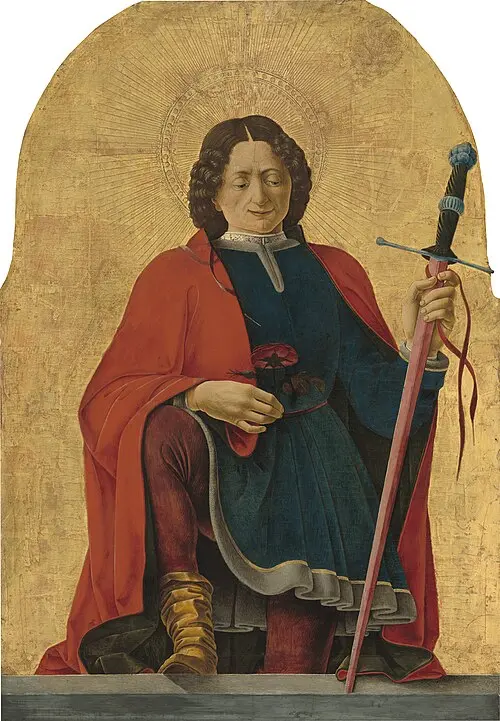
Saint Florian
by Francesco del Cossa, about 1473. Vatican News identifies this artwork in its Polish history of the saint.
May 4
Catholic feast day
304
Traditional year of martyrdom
Lauriacum
Present-day Lorch near Enns
Noricum
Roman province in modern Austria
What historians can say
The core account places Florian in Roman Noricum in 304.
Florian was an imperial official and former Roman military officer. Catholic sources place him at Lauriacum, an important Roman settlement in the province of Noricum Ripense.
During the Diocletianic persecution, Florian openly identified himself as a Christian and refused an order to sacrifice to the Roman gods. He was condemned and drowned in the Enns River with a heavy stone tied to him.
- He is remembered as a martyr because he died rather than renounce the Christian faith.
- The Roman Martyrology commemorates him at Lorch on May 4.
- The detailed written account of his martyrdom is later than the event itself.
A useful source warning
The Basilica of Saint Florian explains that the detailed martyrdom account dates to the eighth century. It preserves an older local tradition, but it was not written by an eyewitness.
Historical timeline
From Roman martyrdom to devotion in Austria and Poland.
- Second half of the third centuryCatholic tradition places Florian's birth and early life in the Roman province of Noricum.
- 303 to 304Emperor Diocletian's government issues measures against Christians. Persecution reaches Lauriacum.
- May 4, 304Florian refuses to sacrifice to the Roman gods and is drowned in the Enns River.
- Eighth centuryThe detailed Passion of Saint Florian is written down. It records the trial, martyrdom, and burial tradition.
- 1183 to 1184Relics associated with Saint Florian are transferred to Kraków. Vatican sources differ by one year, so both dates should be acknowledged.
- 1436Saint Florian is named among the principal patrons of Poland, according to the Basilica of Saint Florian in Kraków.
Reading the artwork
Military dress, water, and the millstone tell different parts of the story.
Artists identify saints through attributes, which are objects or clothing connected with a saint's life. Saint Florian may appear in Roman or medieval military clothing because of his public service.
- A stone or millstone refers to his death in the Enns River.
- A bucket or pitcher of water refers to his later patronage against fire.
- A burning building connects him with firefighters.
- A palm branch identifies him as a martyr.
History and later tradition
The martyrdom by drowning belongs to the early written tradition. The familiar image of Florian pouring one bucket of water on a burning building developed later. A careful report should not present the bucket story as an eyewitness account.
Fire, water, and soap boilers
Why is Saint Florian a patron of soapmakers?
The Vatican City State lists firefighters, potters, blacksmiths, soap makers, and brewers among Saint Florian's patronages. These occupations historically worked around furnaces, heated vessels, or fire.
Soapmaking also joined heat and water with a caustic alkali. That makes Florian's protection meaningful to the trade, but the exact date and origin of the soap-boiler connection are not firmly documented in the early martyr account.
- Well documented: Florian was honored as a martyr associated with Lauriacum and the Enns River.
- Established Catholic devotion: he became a patron against fire and of firefighters.
- Later occupational patronage: Catholic sources include soapmakers and several other fire-related trades.
304
A change of allegiance
Florian held public authority within the Roman system. The martyr account turns on his refusal to let that position decide his religious allegiance.
Saint Florian in Poland
Kraków became a major center of devotion.
Relics associated with Saint Florian reached Kraków in the twelfth century. A church was built in his honor outside the medieval city walls, and devotion spread through Poland.
- Vatican News reports relics at Wawel Cathedral and the Basilica of Saint Florian in Kleparz.
- The Kraków basilica connects the transfer with Pope Lucius III and Casimir II the Just.
- Saint Florian became one of Poland's principal patrons in 1436.
- His feast remains May 4, which is also closely associated with firefighters.
Why this matters in a report
Saint Florian lived in the Roman world, but his cult developed across medieval Central Europe. The Polish history shows how the memory of an early Christian martyr could become part of a nation's religious life centuries later.
For STUDENTS
Questions worth exploring
- What did loyalty mean for a Roman official who was also Christian?
- Why does the Church call Florian a martyr?
- How did water and fire enter his iconography?
- Why did devotion spread so strongly in Poland?
- Which details come from history, and which come from later tradition?
Research sources
Start with Catholic and historical sources that explain what they know.
The links below support the dates, locations, devotional history, and artwork discussed on this page.
Vatican City State
A concise Catholic account of Florian's Roman service, martyrdom, relics, and patronages.
Vatican News in Polish
A Polish Catholic account of the martyrdom, Kraków relics, and Francesco del Cossa artwork.
Basilica of Saint Florian
The Kraków basilica distinguishes the eighth-century martyr text from earlier tradition and documents Polish devotion.
Saint Florian in art
An academic iconography guide explains the millstone, military dress, water, and burning-building imagery.
Sourced prayer
Prayer and historical research have different purposes.
A research paper explains sources. Prayer asks for a saint's intercession. The prayer links below are provided with their Catholic sources rather than being rewritten or attributed without evidence.
Prayer for firefighters
Richard Cardinal Cushing, the late Archbishop of Boston, is credited with this English prayer asking for Saint Florian's intercession for firefighters.
Polish prayer and litany
A Polish Catholic parish publishes a longer prayer and litany that reflects Saint Florian's place in Polish religious life.
Planning for employees?
Storytelling Through Soapmaking is the workplace experience.
If you need an activity for a company team, ERG, appreciation event, retreat, or offsite, return to the corporate workshop path.
A craft worth making time for
Continue through the Soapmaking Library.
Explore practical soapmaking instruction alongside maker history and faith.